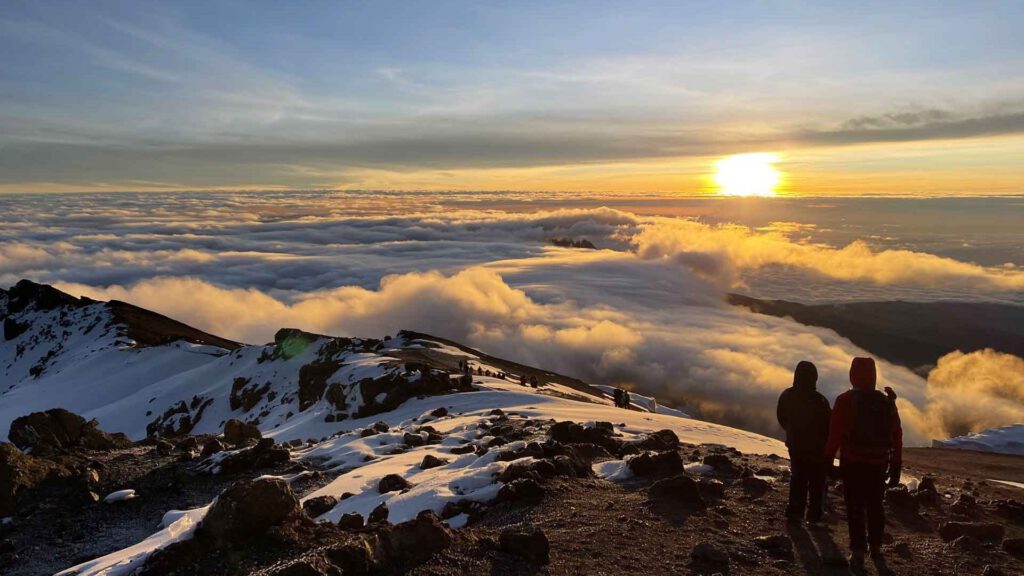
When people think of Mount Kilimanjaro, they picture Africa’s highest peak, snow-capped and rising majestically from the plains of Tanzania. But beyond its beauty lies an impressive geological truth: Kilimanjaro is a volcano — in fact, it’s a combination of three distinct volcanic cones.
The Three Volcanic Cones
Kibo – The central and tallest cone, reaching 5,895 meters (19,341 feet) at Uhuru Peak, Africa’s highest point. Kibo is dormant, meaning it’s not currently active but could erupt again in the future. The last major eruption is thought to have occurred around 360,000 years ago, with minor activity as recent as 200,000 years ago. Today, you can still find a large crater at the summit — the Reusch Crater — and even some geothermal activity inside it.
Mawenzi – The second-highest cone at 5,149 meters, located to the east of Kibo. Mawenzi is extinct, with no possibility of future eruptions. Its rugged, eroded spires are a climber’s dream and a striking feature for photographers.
Shira – The oldest of the three, once a massive volcanic cone that has since collapsed into what is now the Shira Plateau. It’s also extinct, with no volcanic activity for over 2 million years.
How Kilimanjaro Formed
Kilimanjaro’s story began roughly 2.5 million years ago, when movements in the Earth’s crust along the East African Rift Zone triggered volcanic activity. Over time, successive eruptions built up the three cones we see today.
Shira erupted first, then collapsed into a caldera.
Mawenzi formed next, growing into a jagged peak.
Kibo rose last and remains the youngest and largest of the three.
Is It Dangerous?
Kilimanjaro shows no signs of imminent eruption. Scientists classify it as dormant, not extinct, due to the geothermal heat and occasional gas emissions from the Kibo crater. Climbers sometimes notice warm areas on the summit, a reminder that there’s still heat deep inside.
A Volcano Unlike Any Other
What makes Kilimanjaro unique is its combination of glaciers at the summit, tropical forests at its base, and volcanic origins. This blend of fire and ice draws thousands of trekkers every year, making it not just a geological wonder but also a symbol of natural beauty and endurance.